What are the Best Kitchen Countertop Materials
The kitchen is the heart of the home, which is exactly why choosing the right countertop material deserves more thought than picking whatever looks best in a showroom. When you’re remodeling or building new, it’s worth remembering that a countertop has to perform for years under real daily use, not just photograph well on the day it’s installed. The best materials are the ones that score well across the factors that actually matter: appearance, functionality, maintenance, and long-term durability.
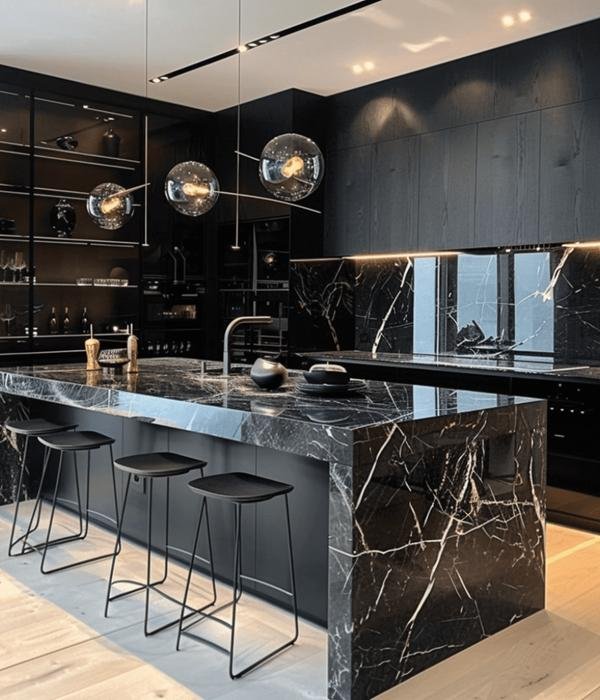
This guide walks through five countertop materials that consistently score high across those categories — three natural stone options and two engineered, man-made alternatives. The list isn’t ranked in any particular order, since the right choice ultimately depends on your kitchen, your cooking habits, and your lifestyle. As a longtime fan of natural stone, we’ll start there before moving into the engineered options.
Quartzite Countertops
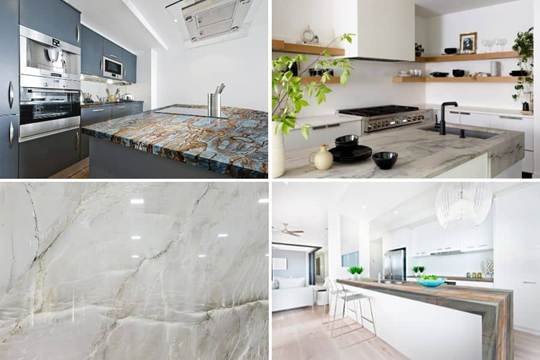
Quartzite is a natural stone, specifically a type of metamorphic rock. It begins its life as ordinary sandstone, which then transforms into quartzite under the immense heat and pressure found deep within the Earth’s crust. That geological process is what gives quartzite its exceptional hardness and its wide-ranging color palette. You’ll find quartzite slabs in soft, light tones like white, grey, and beige with subtle veining, as well as more dramatic variations featuring bold colors like green, burgundy, blue, and black with striking vein patterns.
Because it’s such a hard stone, quartzite is naturally scratch resistant, and it holds up well to heat too — you can set a hot pan directly on a quartzite surface without worrying about damage. That combination of durability and heat resistance makes it a strong choice for both indoor kitchens and outdoor cooking spaces.
As a natural stone, quartzite does need to be sealed to protect its longevity and stain resistance, but this is a low-effort task, typically required just once a year. The main trade-off is cost: quartzite tends to be considerably more expensive than granite, though most owners find the investment worthwhile given how little upkeep it demands beyond that annual sealing.
Granite Countertops
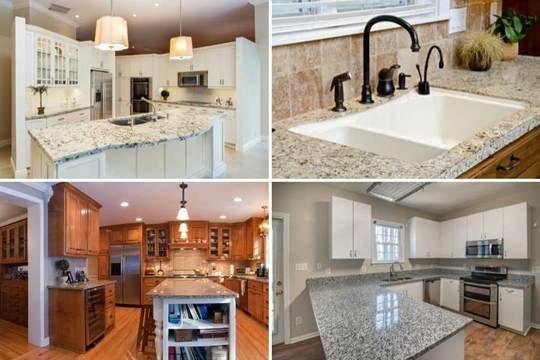
Granite has held a spot among the best countertop materials for decades, and for good reason. It’s a coarse-grained igneous natural stone made up primarily of quartz, feldspar, and mica, and it performs beautifully in both indoor and outdoor kitchens.
Granite is available in an extensive range of colors, spanning whites and browns through greens and blacks, and one of its defining visual traits is a distinctive speckled appearance. That speckled look has become slightly less trendy in recent years as quartzite has risen in popularity, but granite remains a dependable, timeless option.
Like quartzite, granite is a very hard, heat-resistant stone, so hot cookware can go straight onto the surface without concern. It’s also particularly well suited to outdoor kitchens, since direct sunlight and high temperatures don’t affect the slab.
Granite is porous, though, which means it needs periodic sealing to stay protected — generally just once a year is enough to keep it performing well, making it a genuinely low-maintenance material for the durability it offers.
Marble Countertops
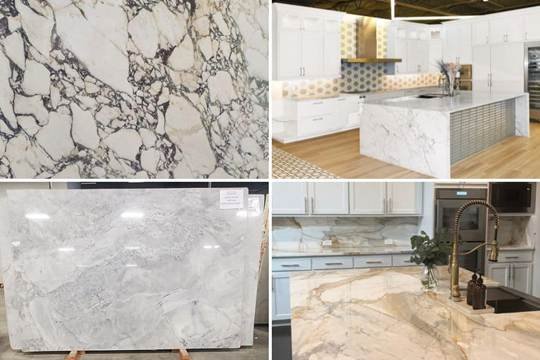
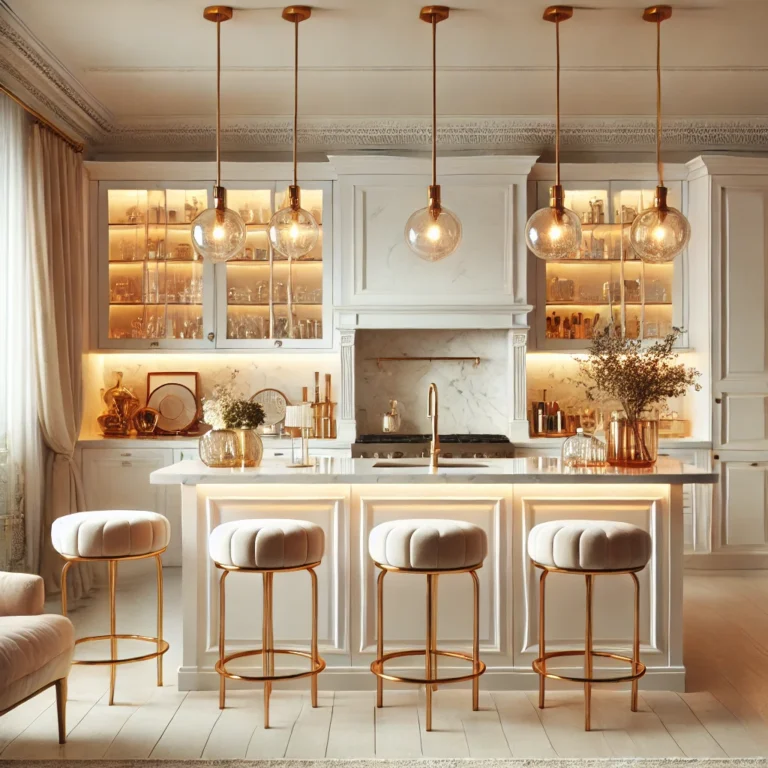
Marble’s origin story is genuinely fascinating. It starts deep within the Earth’s crust as limestone, a sedimentary rock, which is then transformed by intense heat and extreme pressure over an immense span of time. That slow geological process is what produces the beautiful, veined stone we know as marble. When most people picture true luxury in a kitchen, marble is often the first material that comes to mind — its aesthetics, and especially its distinctive veining, are hard to match.
While marble is closely associated with classic white tones, its most captivating quality is often the dramatic veining that runs through shades of green, blue, grey, and even gold. Darker marble varieties exist as well, for anyone drawn to a moodier palette.
As stunning as it is, though, marble comes with real trade-offs. It’s a softer, more porous stone than granite or quartzite, which makes it more prone to scratching, and a cold drink left without a coaster can leave a visible etch mark. Acidic foods like lemon juice or tomato sauce can also damage the surface, so using a cutting board during food prep is essential. Marble’s heat sensitivity also makes it a poor fit for outdoor kitchens.
Given its luxurious character, marble understandably requires more upkeep than the other stones on this list. Regular sealing is essential — every six months is a safe rule of thumb — and keeping coasters and hot pads within easy reach makes a real difference in day-to-day care. Marble also tends to be one of the pricier options available, but for many homeowners, the beauty it brings to a kitchen makes it worth the extra investment and maintenance.
With the natural stone options covered, it’s worth turning to the two leading engineered materials on the market.
Quartz Countertops
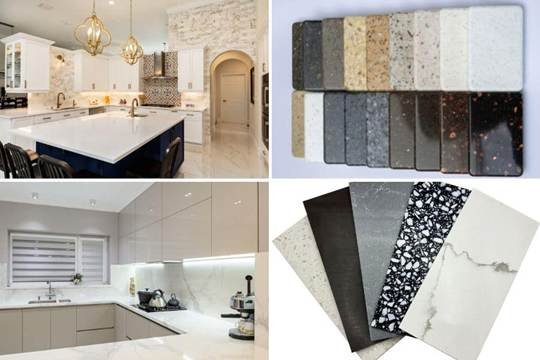
Quartz countertops are an engineered material made from roughly 90 percent crushed quartz particles — a natural mineral found abundantly in the Earth’s crust — combined with resins, pigments, and occasionally other minerals.
That mixture is molded and baked into slabs, resulting in a surface that’s both highly consistent and remarkably durable. Quartz stands out for being extremely hard and completely non-porous, which gives it excellent scratch resistance right out of the box.
It can also handle a reasonable amount of heat, though it isn’t as heat-proof as granite, so it’s worth using trivets under hot pans rather than setting them directly on the surface. Quartz isn’t recommended for outdoor use, since the resin in the slabs can react poorly to prolonged UV exposure.
One of its biggest advantages is that it’s naturally stain resistant, which means there’s no need for periodic sealing at all. It also comes in an extensive range of colors, and many quartz surfaces are engineered to closely mimic the look of natural stone, including marble. Quartz typically costs a bit more than granite, particularly in the varieties designed to resemble natural stone, but for busy households, the low-maintenance durability often justifies the price.
Porcelain Countertops
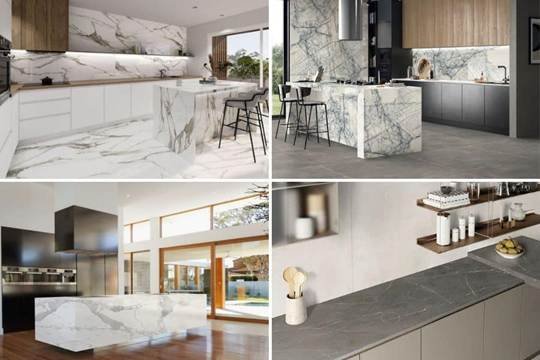
Porcelain countertops start out as natural clay, which is then fired at extremely high temperatures to produce a surface that’s exceptionally dense and tough. The result holds its own visually against natural stone and other premium countertop materials, while offering a distinct set of practical advantages.
Porcelain handles heat exceptionally well, resists staining, and comes in a wide range of design options — including finishes that mimic the look of natural stone, concrete, or marble. It’s highly durable and requires no sealing at all, which makes it a genuinely low-maintenance choice. Its heat resistance also makes it a strong candidate for outdoor kitchens, where hot cookware and direct sun are simply part of daily use.
The main thing to watch for is chipping: if the edge takes a hard knock, that damage generally can’t be repaired. Porcelain slabs also come in a slim 2cm thickness that requires specialized installation, and between that installation process and material cost, porcelain can carry a higher overall price tag. Even so, many homeowners find the combination of durability, heat resistance, and design flexibility well worth it.
Nearly all of the materials covered here are available in a range of finishes, including polished (a glossy surface), honed (a soft, satin look), and leathered (a textured, matte finish), so there’s room to fine-tune the final look no matter which stone you land on.
There’s no single “best” countertop material that works for every kitchen — the right choice really comes down to your lifestyle and personal taste. Marble was the right fit here, given a love of natural stone and a kitchen that doesn’t see especially heavy daily cooking, and while porcelain and quartz can convincingly mimic the look of natural stone, nothing quite replaces the real thing for those who want it.
On the other hand, for a busy household — say, a home with growing kids and a lot of daily cooking — a durable, dramatic quartzite is often the smarter pick, since it skips the constant worry over coasters and cutting boards.
When you’re browsing stone yards for your own kitchen and something catches your eye, always ask what type of material it actually is. Now that you know how each option performs, you’ll be well equipped to choose the countertop that’s genuinely right for your home.
Frequently Asked Questions
Marble should generally be sealed at least once or twice a year to protect it from staining and etching. Kitchens with heavier daily use may benefit from sealing on the more frequent end of that range.
It’s best to use a trivet rather than setting a hot pan directly on quartz. While quartz can tolerate moderate heat, it isn’t as heat resistant as granite, and direct contact with very hot cookware can risk damaging the surface over time.